Forensic meteorology is the scientific study and reconstruction of past weather conditions for a specific time and location. Forensic meteorologists – sometimes called “weather detectives” – are critical contributors to thousands of legal cases every year. If a hurricane, tornado, thunderstorm, lightning strike, ice storm, or other weather event leads to injury, property damage, or is a factor in a crime, it is up to a forensic meteorologist to make sense of sometimes conflicting data or information.
It hasn’t always been this way in the United States legal system. Before weather observations became regular and numerous, judges frequently decided cases using general assumptions and eyewitness accounts. This article will take you through some of the history of weather in court and how forensic meteorology become recognized as integral to properly resolving cases.
Pre-Expert Era
Before the mid-19th century, early weather-related cases were most common for marine storms and shipping losses. In general, courts relied on eyewitness accounts and more general weather knowledge to decide whether losses incurred during storms were the result of “Acts of God” or human negligence. Modern weather instrumentation had only recently been developed and deployed around the world. Thus, forensic meteorology wasn’t even a thing yet, because there wasn’t much data available to reconstruct events.
One of the earliest weather-related published cases is Mein, Mackay & Co. v. West (1808). A severe storm in 1804 had caused shipping losses, but the judge decided that the storm was an “Act of God” and could not have been predicted or protected against by the defendant. In his decision, the judge asks “Was it practicable – was it physically possible, for human exertion to repel the accidents which resulted from the storm of 1804?” No data were available to testify to the severity of the storm, so there was no use for a meteorological expert to weigh in. The defense won.
Another case – Tompkins v. The Dutchess of Ulster (1851) – arose when a cargo steamboat sank in the Hudson River. Plaintiffs sued the shipping company for the value of the contents. The defense claimed that the storm was an “Act of God”, excusing reliability for the loss. However, depositions from the boat pilot and crew suggested that a leaky boiler and weaknesses of the ship’s hull were the primary causes of the loss. The plaintiffs prevailed.
Abraham Lincoln – First Forensic Meteorologist?
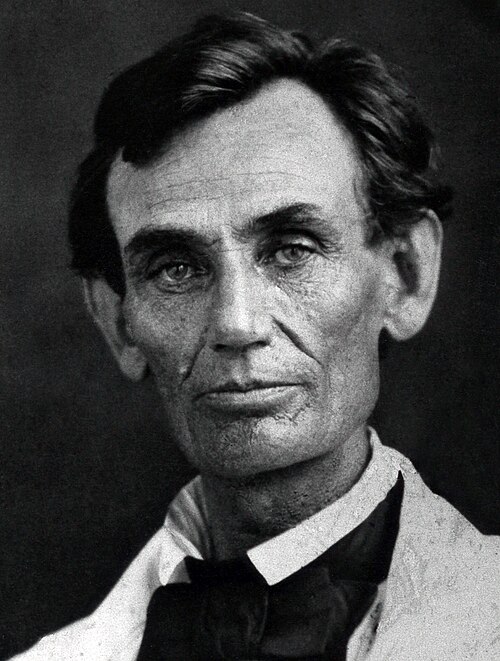
It is well known that Abraham Lincoln – 16th President of the United States – practiced law in Illinois prior to his ascendancy to national leadership. Late in his career, he defended an accused murderer in People v. Armstrong (1858). A critical piece of testimony was from a witness who claimed to see the defendant commit the crime at around 11 pm at night from 150 ft. away. To refute this claim, Lincoln produced moon phase data from the Old Farmer’s Almanac that showed the moon was low to the horizon and only in it’s first quarter phase at the time – making it impossible that the witness could see anything at that distance. The jury unanimously acquitted the defendant of the crime.
A brief side note. Somewhat surprisingly (to me at least), data from the Old Farmer’s Almanac has been admitted for use in modern litigation – but only for sunrise/sunset data. Obviously, using the almanac information for forensic or weather forecasting purposes is unwise and would likely lead to disqualification of any argument reliant on it.
Consulting Meteorologist Era
As the frequency and spatial coverage of meteorological measurements grew in the late 19th century, it became increasingly desirable to find meteorologists who could accurately interpret the data for legal applications. Now, court cases frequently hinged on objective, quantitative analysis rather than subjective eyewitness reports and general weather knowledge.
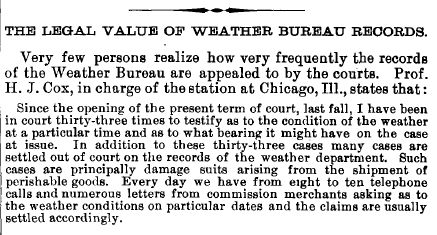
A short paragraph published in the American Meteorological Society journal Monthly Weather Review (March 1900) provided a glimpse into one person’s activity in consulting meteorology. H.J. Cox headed up the U.S. Weather Bureau’s (modern day National Weather Service) Chicago office. He wrote that he had appeared in court thirty-three (!) times in just a few months to testify about weather data being used in trial. Cox also noted that there were many other cases that were settled out of court, and that his office received 8-10 calls daily from parties asking about weather conditions.
With the explosion in demand for weather experts, there was momentum by the mid-20th century to establish a certification process for consulting meteorologists. The American Meteorological Society (AMS) developed the Certified Consulting Meteorology (CCM) certification and introduced to the community in November of 1957. The CCM board awards the CCM designation to meteorologists after a rigorous certification process involving tests of knowledge, communication, and ethics. It’s purpose is to enable users of meteorological data and services to select consultants that meet the highest standards of excellence in the field. As of October 2026, there have been 821 individuals who have earned the CCM designation; 236 are active as of this writing.
Modern Data Era
The exponential increase in weather data led to a similar increase in demand. Meteorologists now routinely archive petabytes of data from around the world each day. Notably, the development of weather satellites and modern weather radar systems sparked a discrete jump in data during the 1960s and 1970s. These data sources have become increasingly important in reconstructing historical events, diagnosing lightning strikes, determining hail size, quantifying rain rates and accumulation, assessing hurricane structure, and much more.
The AMS sponsored the first Conference on Forensic Meteorology, held in November, 1976 in New Orleans. Conrad Gosset presented the keynote address for the conference. He spoke on the numerous examples of cases for which he prepared reports while working as a broadcast meteorologist in New York City. Although consulting meteorologists had now been operating in the legal area for some time, Gosset coined the name “forensic meteorology” to describe the field a few years earlier. Other speakers presented interesting papers as well, including the Lincoln case and the famous complaint against Ethel Kennedy – accused of stealing a horse.
Today, forensic meteorology has evolved from subjective opinions of weather events to targeted, objective assessments using many kinds of weather data. Organizations like the Association of Consulting Meteorologists (ACM) and the AMS provide guidance, standards, and policy that inform consulting meteorologists and the legal system. CCMs now run their own businesses or work for larger consulting firms to help satisfy the increasing demand for their services. The emergence of artificial intelligence (AI) in society has not extinguished the need for seasoned forensic meteorologists; rather, AI streamlines their work and allows for more robust research for cases. Forensic meteorology remains a growing industry with increasing demand for new CCMs each year.
References
Certification Program for Consulting Meteorologists, 1982. Bulletin of the American Meteorological Society, Vol. 63, August 1982. Available online at https://journals.ametsoc.org/view/journals/bams/63/8/1520-0477-63_8_907.pdf
Certified Consulting Meteorologists Directory, cited 2026. Available online at https://www.ametsoc.org/ams/education-careers/careers/ams-professional-certification-programs/directories-of-ams-certified-individuals/list-of-ams-certified-consulting-meteorologists-ccm/
Gosset, C.B., 1976: An Overview of Forensic Meteorology. 1st Conference on Forensic Meteorology, American Meteorological Society, New Orleans, LA. Abstract available online at https://doi.org/10.1175/1520-0477-57.8.1053
People v. Armstrong, 1858. Available online at https://www.almanac.com/abraham-lincoln-almanac-and-murder-trial
Dr. Chris Hennon is the Founder and Lead Consultant for Hennon Weather Services LLC. He is a Certified Consulting Meteorologist and former Professor of Atmospheric Science with expertise in Tropical Meteorology and Weather Forecasting.