The Legends of Meteorology series investigates the most famous historical figures in weather. I will go beyond a simple recount of the great work that helped them to achieve legend status by evaluating their status in several other ‘non-standard’ categories. Along the way you will likely learn some new things about each person.
As you peruse the categories, click on them for more information about what they are and how legends are evaluated. The numerical ratings are from 0 to 99 (elite). You can check out other legend articles here:
| Legend | Overall Rating |
| Ben Franklin | 92 |
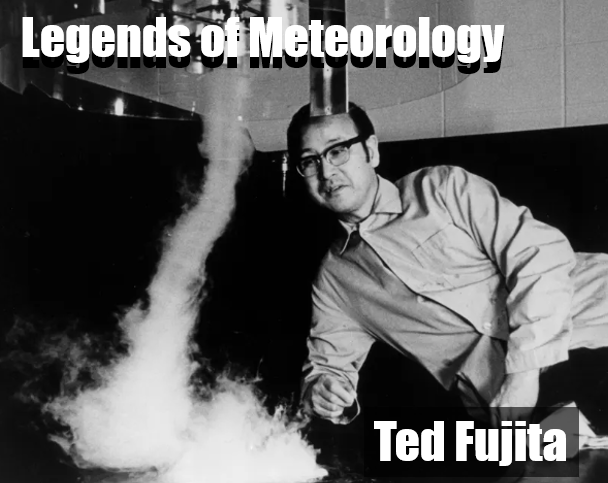
Today’s legend is Tetsuya “Ted” Fujita, legendary tornado researcher.
Scipio Africanus (Name Coolness) 92
Loosely translated, ‘Tetsutya’ means ‘boy of philosophy’, which is appropriate. And it has a roll off the tongue satisfaction to it when said out loud. His adopted American name is Theodore, or Ted. ‘Theodore’ has a Greek origin which means ‘God gift’. For me personally, when I hear Theodore, I am immediately taken back to watching reruns of Leave it to Beaver when I was a kid – not a bad memory for sure. ‘Ted’ is kind of vanilla and most recently associated with an anthropomorphic teddy bear who likes the ladies, beer, and weed – not the first things that come to mind with Fujita.
Fujita’s nickname is ‘Mr. Tornado’. Sounds like a superhero. Perhaps he beats the bad guys by luring them into suction vortices or spawning microbursts on them? Negative points for being named Mr. Tornado but not actually seeing one until he was 62 years old (!). That would be like if Babe Ruth, the ‘Sultan of Swat’, was a singles hitter and got his first homer in his 20th season.
Contributions 97
Fujita had a Rolling Stones-esque run, with nearly 40-years of very consistent research and publications beginning in the early 1950s. He began his work in Japan by identifying what would later be called mesocyclones, which are basically the larger parent circulations of tornadoes. He is best known for his work documenting tornado damage via post-storm aerial and ground surveys, photographs, video, and first-hand accounts. This led to the development of the Fujita scale (F-scale) for tornado classification, which ranked the maximum wind speed of tornadoes from 0-5. The scale was later revised to what is now known as the Enhanced Fujita (EF) scale.
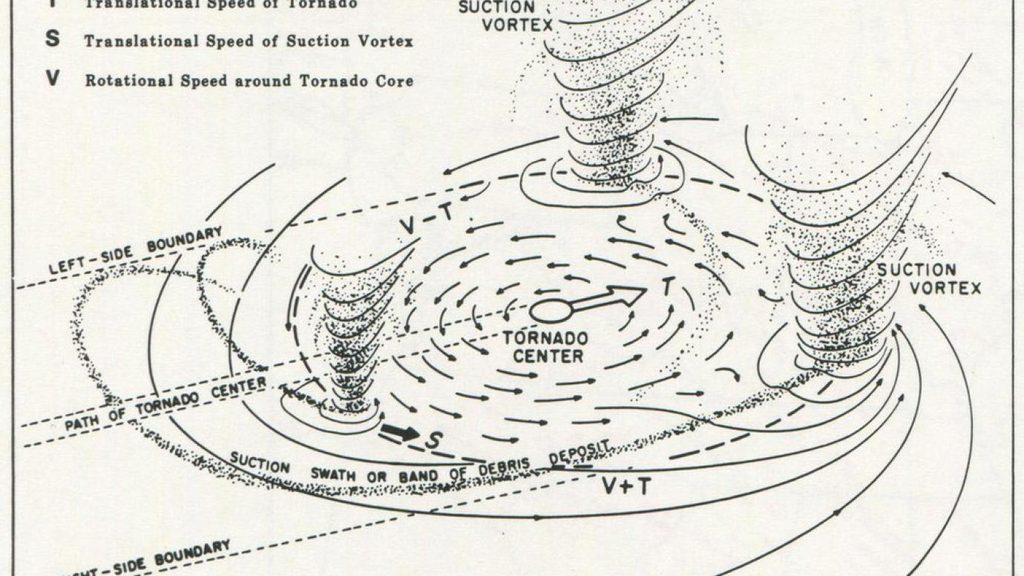
All of Fujita’s best-known work emerged from his intense and comprehensive observational tenacity. He discovered the existence of ‘suction vortices’, which are small mini-tornadoes that circulate about the parent tornadic vortex, literally pulling up trees, barn animals, and structures. Fujita did not observe them personally; he postulated their existence by inference from post-storm photographs of cycloidal (spiraling) damage patterns.
Fujita was a weather detective. When Eastern Airlines Flight 66 crashed at JFK airport short of the runway in 1975, he conducted a detailed meteorological analysis and determined that an intense microburst caused the accident. Fujita’s work uncovering a previously unknown, hazardous phenomena was a critical development in improving aviation safety. He provided clarity in a confusing landscape of thunderstorm winds.
Youth Potential 84
Fujita was born into a modest family of educators who lived in a small Japanese village of about 1,000 residents. He had a traditional education while showing signs of a careful and maybe even obsessive observer. At age 15, he set up a solar experiment for a school project. Using a solar slit projection, he counted sunspots and calculated an estimate of the speed of solar rotation. When a typhoon was lashing the village, Fujita was on the rooftop of his home trying to determine the wind speed.
His father encouraged Ted to go on and be a teacher. Fujita studied mechanical engineering and considered attending Hiroshima College for his teaching degree. Fortunately for him, he ultimately chose a different school and avoided the nuclear attack in 1945.
Fujita never travelled more than 30 miles from his birth home as a child and young adult. That would change in a big way when his graduate work at Tokyo University was noticed by researchers at the University of Chicago in 1953.
Athleticism 65
The name ‘Mr. Tornado’ certainly did not apply to athletic endeavors. Fujita was not brought into this world to dunk a basketball or put a little white ball into a hole. He was slight of frame, nearsighted, and never seen on a baseball diamond or track – unless it was hit by a tornado!
But as far as general fitness, Fujita scores positively. He tirelessly conducted ground damage surveys for his work. He spent hours cooped up in small Cessna planes so that he could take photos of tornado damage areas. When he noticed a few extra pounds coming on from that good ole’ American diet, Fujita made it his mission to take the weight off through careful analysis of his diet and activity. We need more of that today!
Online Dating Profile 74
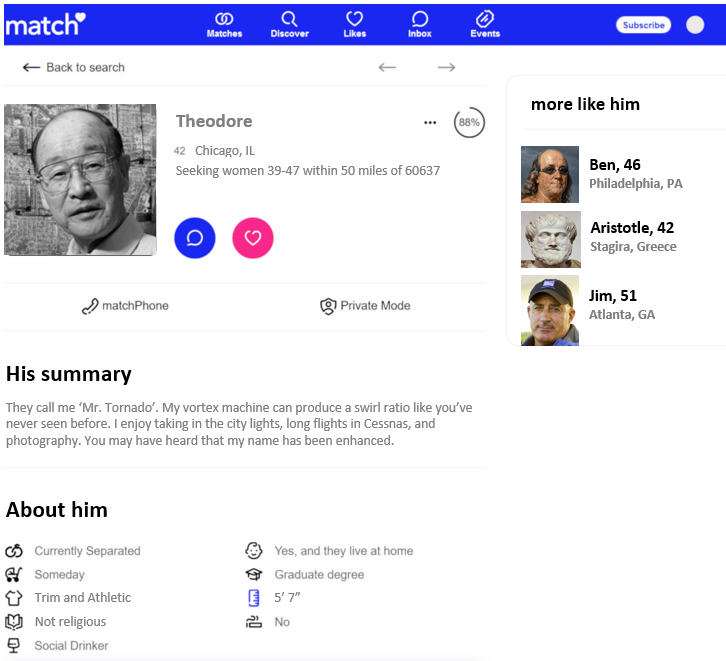
Nerd factor is uncomfortably above normal to be considered a player but Fujita makes up for it with unending, interesting stories about travel and research adventures. His Japanese upbringing adds a bit of exoticism for potential suitors.
Fujita had a tendency to document and chart just about everything he did. He once had the honor of sitting in the cockpit of the supersonic Concorde jet for a trip to NYC from Paris. Instead of enjoying the ride, he took regular observations of the aircraft performance and weather and then made charts upon his return. I wouldn’t be surprised if he charted his daily trips to the restroom. This could make dates uncomfortable.
Rate My Professor 85
High points for teaching experience. Fujita began his career by teaching physics as an assistant professor immediately after college, which was and still is very rare. Funny story, he chose meteorology as his graduate focus of study because it was the cheapest scientific discipline to get into!
He was hired at the University of Chicago as a research professor in 1953. Ted became a tenured associate professor in 1962 and full professor (the highest rank) just three years later. In total, Fujita was a teaching faculty member for 29 years. He supervised 23 graduate students who earned Masters and Ph.D. degrees and taught numerous courses.
Despite all of this experience, I was not able to find too much information on his quality as a professor. In my experience, highly successful research faculty do not make great teaching faculty, but there are exceptions of course (see Richard Feynman). While Fujita the researcher is well known for teasing out simple and sensible concepts from chaotic data, I’m not certain whether his students in the classroom benefited from the same ability from Fujita the teacher.
Hobbies 72
The man didn’t have much time for hobbies. In an oral interview with the American Meteorological Society, Fujita was asked what he did outside of working hours. He replied that he didn’t keep working hours, because “Five days I teach, two other days I collect and maintain storm data”. Hopefully he had time to take his wife out to dinner!
The hobbies Fujita did pursue seemed to be connected to his professional work. He was into photography, especially of clouds and storms but also sights while traveling. In his youth he became an amateur spelunker. Fujita and a friend discovered a cave on one of their hikes, explored it, and then named it after themselves.
Survivor 88
Fujita would be a decent Survivor contestant whenever the challenges involved analytics and/or observation. He would kill it. As a child, he was able to gather his own food – hunting clams and fish in nearby tidal pools. He also frequently gathered mushrooms for consumption. His colleagues note his “creative independence, relentless determination, and obsessive curiosity”. These are all good attributes to have on Survivor.
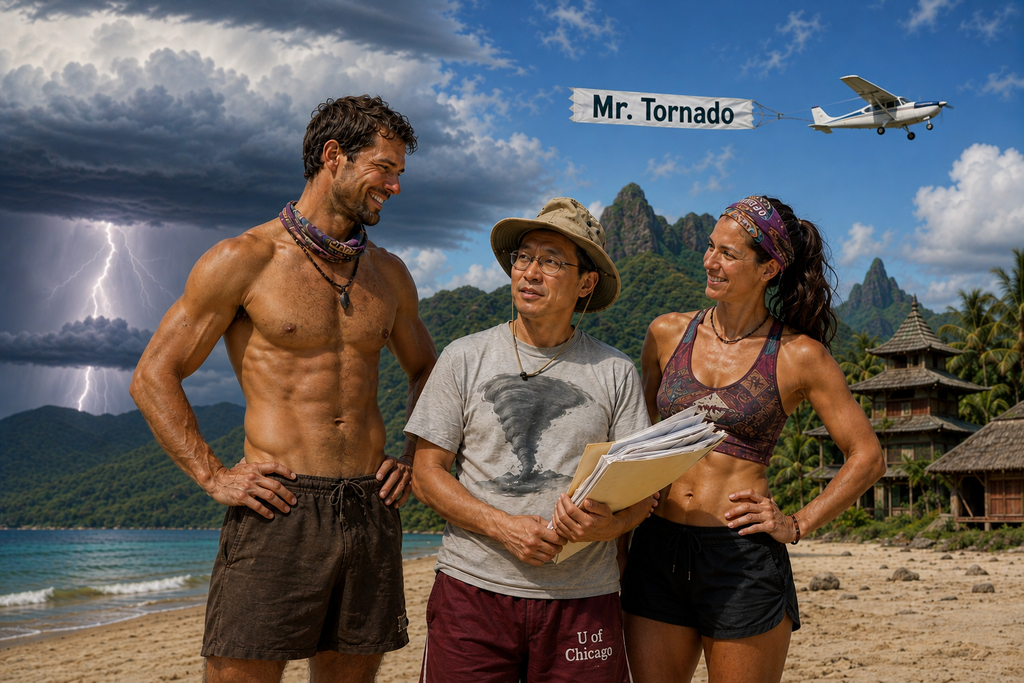
It would all come crashing down if there was a physical-based immunity challenge. Although Fujita kept himself in good shape, he would likely be dominated by the more athletically inclined younger crowd.
Beard 0
Fujita was always clean shaven in public. This isn’t surprising given modern Japanese culture, which attaches the look to professionalism and tidiness. It hasn’t always been that way – beards were common, especially in the military in the 15th and 16th centuries.
Beer Buddy 94
This is a little tricky because there are many people alive today who were students and/or colleagues of Fujita that knew him personally. All I can do is guess based on what I’ve learned. Greg Forbes, if you’re out there reading this, please reach out!
We know that Fujita enjoyed beer. That alone qualifies him as a beer buddy. He had endless stories that could fill any uncomfortable silences in the conversation. It would be very interesting to learn about his experiences growing up in wartime Japan and his surveys of the nuclear damage in Hiroshima and Nagasaki. Was he apolitical (appeared that way)? Did he experience racism in his post-war times in Chicago? Endless questions.
I don’t think he’d be into bar games like billiards, darts, or Golden Tee Golf. But it would be fun to try to learn just a tiny amount of how he thought about science over a few beers. I’m sure there would be lots of laughter, especially when we compare CVs.
Overall 96
Ted Fujita is universally known as one of the all-time meteorology greats. He had an insanely high power of deduction and reasoning that, when combined with his meticulous attention to detail and talented drawing skills, led to pioneering work in mesoscale meteorology. Fujita loved data! In his memoirs, he presents a timeline of all of the research grants he’s ever won – normalized to the Consumer Price Index.
Yes, kind of a nerd. But the world needs nerds like him. Fujita seemed to have an unbalanced work-life ratio, but I think that was required to launch him into the stratosphere, so to speak. I’m sure he’s up there now, making sure the tornado record remains accurate.
Here’s Dr. Fujita’s player card:
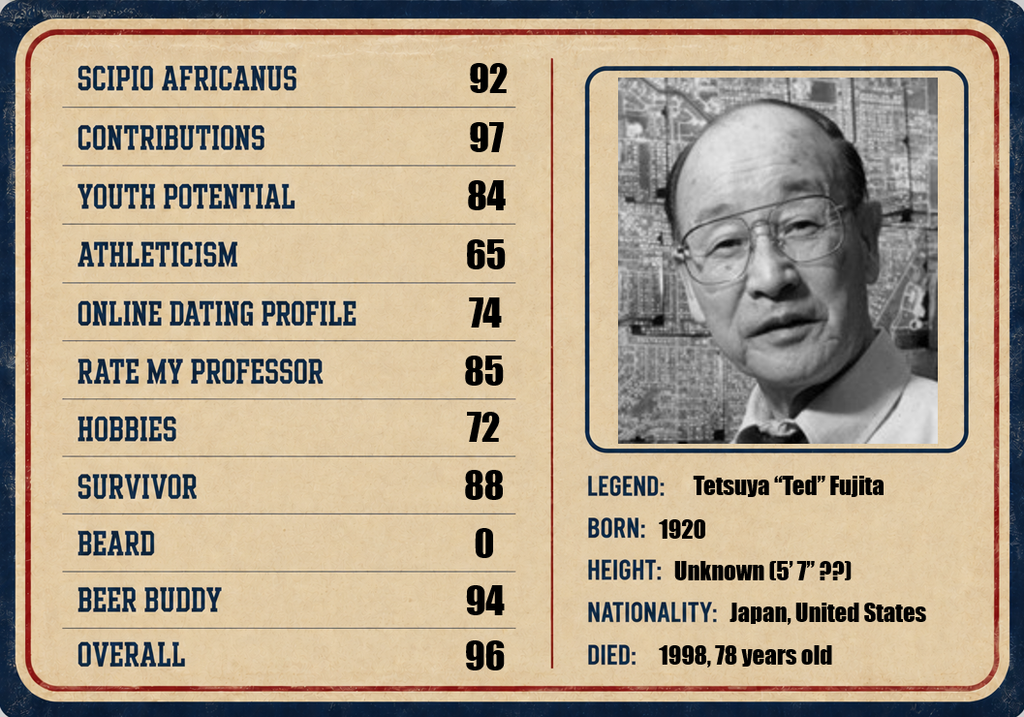
Sources: AMS Interview, Fujita memoirs
Next legend: Vilhelm Bjerknes
Dr. Chris Hennon is the Founder and Lead Consultant for Hennon Weather Services LLC. He is a Certified Consulting Meteorologist and former Professor of Atmospheric Science with expertise in Tropical Meteorology and Weather Forecasting.