To become a meteorologist and get employed by the Federal government, you must get a degree in a program that fulfills the U.S. Office of Personnel Management (OPM) requirements for meteorology employment, called the Meteorology Series 1340. Virtually every U.S. university meteorology program will have their curriculum set up such that you will qualify to work for the National Weather Service or related government job by completing the coursework in their program.
Most of the meteorology courses you will take will be useful, some will be fascinating, and others will have you questioning your life decisions. My purpose here is to give you a little insight on the most practical undergraduate OPM courses – those whose material and applications will reveal themselves nearly every day of your career as a meteorologist. To keep things simple, let’s assume your job is a weather forecaster; this ranking would be dramatically different if it was intended for, let’s say, a Ph.D. research meteorologist.
So here it is, from most to least practical. More information below!
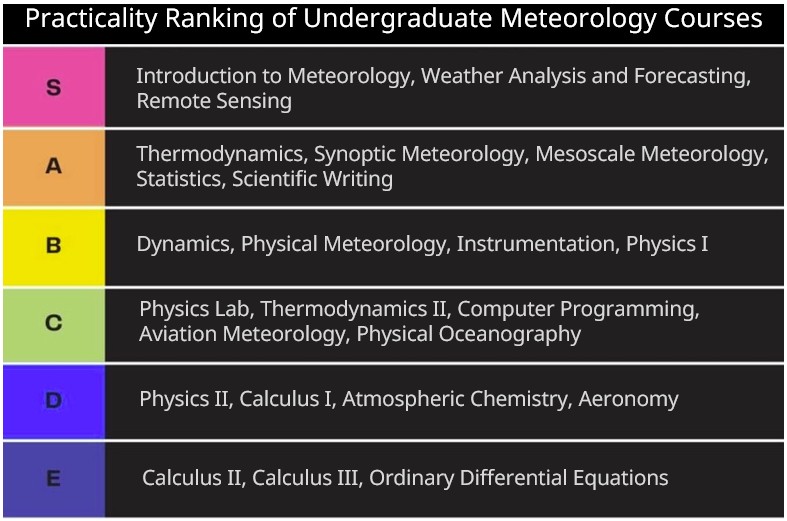
S Tier (Supreme Practicality)
You go to school thinking you know stuff about the weather, but it turns out that there’s a lot more to it than clouds and rainbows. Intro to Meteorology presents a broad overview of a physics-based curriculum in a non-physics manner. You need it for pretty much everything that will follow.
Since this is a practical list for a weather forecaster, Weather Forecasting is of course a critical course. It teaches you about the science of prediction and the tools (i.e. computer models) that meteorologists apply to make them. Weather analysis is usually taught alongside forecasting. You learn all about the plethora of weather symbols (fronts, troughs, types of weather, etc…) and analysis techniques found throughout the field.
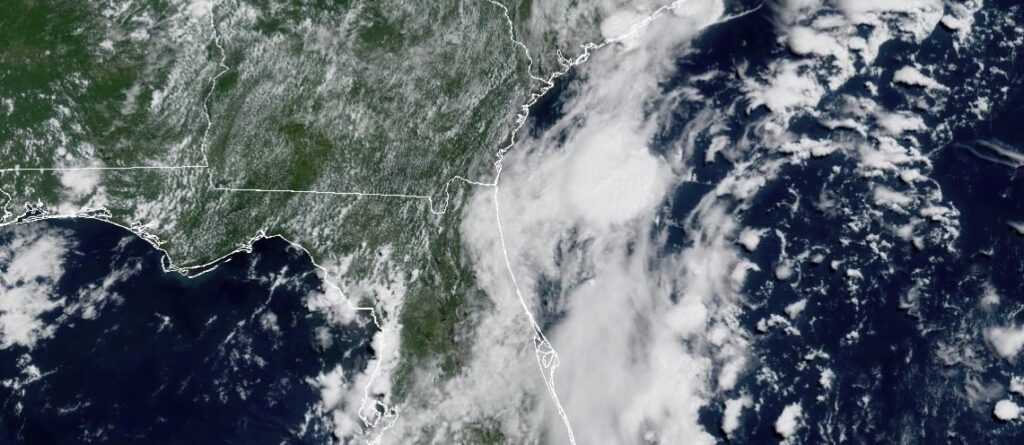
The last course in S tier is remote sensing, which is all about sampling the atmosphere remotely, i.e. satellites and radar. Forecasters use these every day and need to understand how to interpret what they’re seeing. Very practical.
You could be a great forecaster if you mastered just these three courses. But OPM makes you take about 356 more credit hours to get a degree. Let’s dive into the lower realms…
A Tier (Very Practical)
Our first two ‘non-weather specific’ courses make their appearance. Statistics is pretty useful in a number of ways, like applying probabilities, certainty, and understanding ensemble forecasting (the practice of considering large numbers of forecasts instead of one). Forecasters also have to write stuff like forecast discussions and occasionally research reports and/or technical documents; a science writing course will help prepare for that. Technically, writing is not an OPM recommended course – but it should be!
Thermodynamics is traditionally the first ‘hard core’ atmospheric physics course that students take. Unfortunately, it serves as a gateway and many students who came to school expecting a smooth ride to meteorology fame and fortune will decide to pursue other majors. It is a foundational course that covers important stuff like how heat moves around, physical laws of the atmosphere, moisture, and adiabatic motion (a framework for how air behaves as it moves vertically). You will apply the knowledge gained in this course every single day.
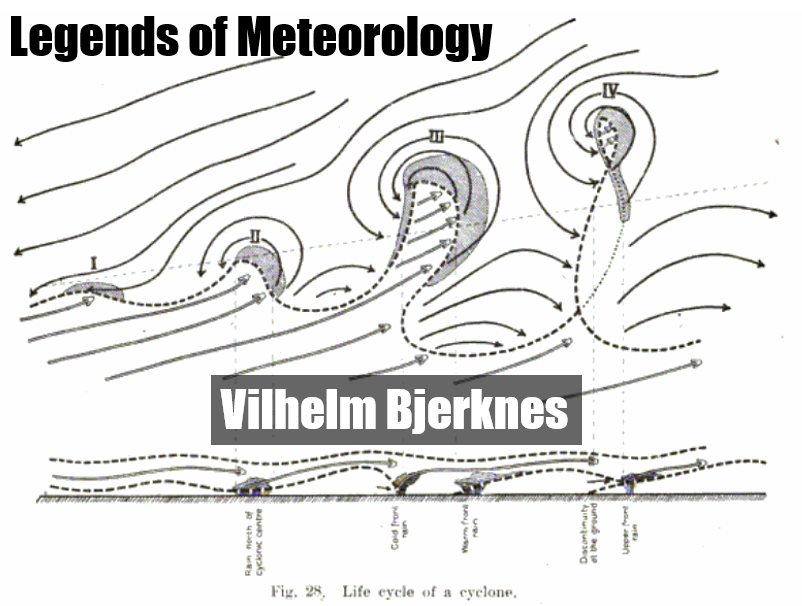
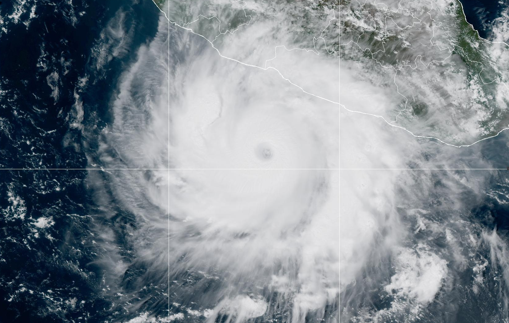
You probably won’t know what ‘Synoptic’ means when you go to school. By the end of your four years, you will realize that most of your job as a forecaster is predicting synoptic-scale phenomena. Things like mid-latitude cyclones, hurricanes, fronts and the such. Important.
Mesoscale Meteorology covers most of the other stuff that you forecast for. Thunderstorms, tornadoes, squall lines, sea breezes, and more. Fun times. This is why you want to be a forecaster.
B Tier (Moderately Practical)
These are courses that are can be moderately technical/intensive and very important for understanding how the atmosphere works – but perhaps not near the top of day-to-day practical use as a forecaster.
Dynamics usually follows the Thermodynamics course. It addresses how air moves around. It does so in a deep mathematical and usually abstract way that makes normal students have nightmares around exam time. Study groups for this course usually devolve into depressive alcohol fueled complaint parties about the textbook.

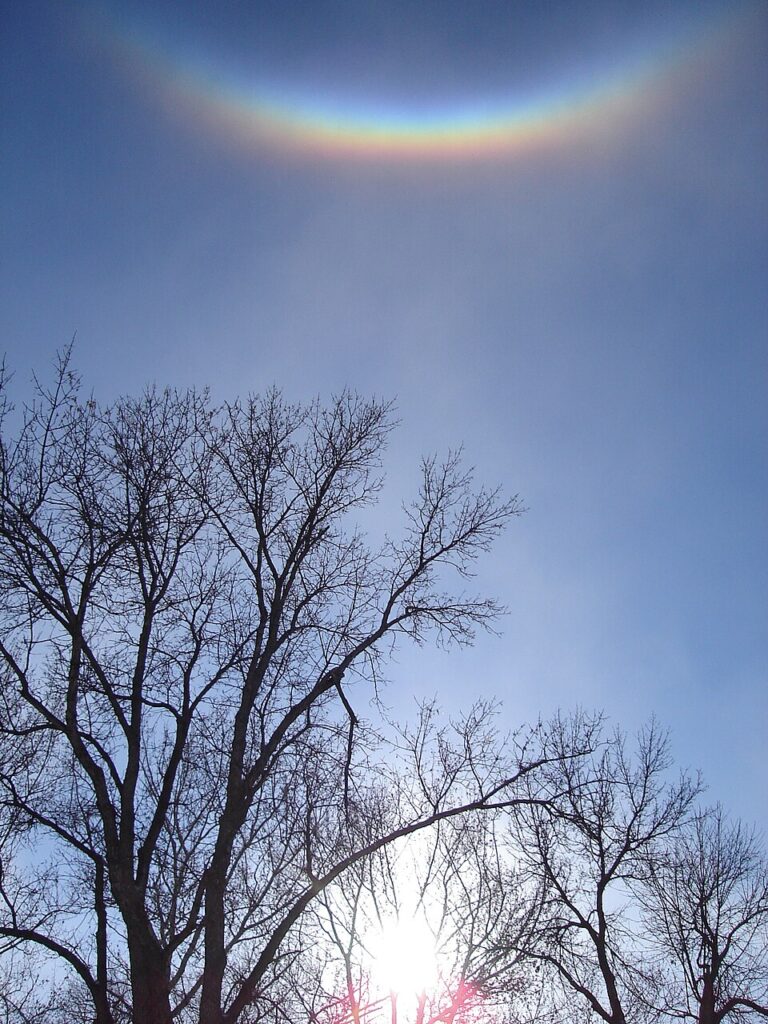
If you’ve ever wanted to know how precipitation forms, the physics of clouds and rainbows, and how energy behaves, Physical Meteorology is a lovely course. Exam averages are around 40% and you’ll forget the details by next semester, but definitely a foundational course with reasonable application to your everyday job.
Meteorological Instrumentation sounds practical on paper. Yeah, it’s important to know how to calibrate barometers and know the error range on thermistor thermometers. And learning the ins and outs of rain gauge observation is a must. But as a forecaster with a tight deadline to get your packages out, you are happy to sweep all of that under the rug and assume that the data you’re looking at is good to go. Other meteorologists get paid to worry about that stuff.
Physics I is the first of two calculus-based physics courses required of meteorology students. Generally, it will cover useful topics for the aspiring meteorologist like gravity, fluids, and energy. But you will be happy to done with the course and move on to more weather specific topics.
C Tier (Limited Practicality)
Courses that some will love, some will hate, and some will avoid if possible. They all could have some application to your job as a forecaster, but not commonly.
Physics lab is definitely a better time than lecture, but you don’t have time for that stuff when there’s a tornado watch for your forecast area and storms are popping up on your radar.
Advanced Thermodynamics (or, Thermodynamics II), is pretty much everything from the first semester but for weather masochists that enjoy diving deep into theory and numerical applications that will never be thought of again once you get that NWS acceptance email.
Don’t get me wrong, learning a computer language is very helpful for your intellectual development/critical thinking and future work as a graduate student – which you almost have to do in order to even have a reasonable chance of working as a paid forecaster. But once you’re there, you will not be whipping out FOR and IF/THEN/ELSE logic while working on your forecast package.
Finally, Aviation Meteorology and Oceanography are usually elective courses that deals with applications to – you guessed it – aviation and the ocean! Stuff like turbulence, icing, density altitude, microbursts, currents, tides, etc… Can be very cool; who doesn’t like wingtip vortices and rogue waves? Very practical if you work as an aviation forecaster or on a boat, not so much at a general NWS office.
D Tier (Devoid of Practicality)
Some of these courses will be optional depending on your specific program. All are of little use to you as a weather forecaster. You will not be performing double slit experiments, solving chemical equations, or dealing with line integrals. Aeronomy, which deals with the upper atmosphere, has a lot of weird stuff which can be very interesting. But unless you end up working for the NWS Space Weather Prediction Center, it’s really only good for impressing your roommates or dates with your knowledge of the ionosphere.
Calculus I is a critical hurdle that you must clear to reach the E Tier. There’s also a bunch of important stuff in there (e.g., derivatives, integrals, finite differencing) that informs other parts of the curriculum, like how weather models work and the foundational equations of the atmosphere. But for your day job, it’s just as practical as molecular biology.
E Tier (Advanced Math Group)
And now we arrive at the reason so many students don’t graduate with a meteorology degree. The OPM requirements only list Ordinary Differential Equations (ODE) as a required course. First of all, if by ‘ordinary’ they mean burning a couple dozen hours a week working out solutions to math problems that Archimedes himself would need to consult AI , then I would hate to experience the Extraordinary Differential Equations course. To add insult to injury, some students fail to realize that they will typically have to take 12-16 credit hours of Calculus to even qualify to take the ODE course. And what about the practical use of ODE topics? None. No one on the NWS operational forecasting staff is doing Laplace transforms and applying the Picard-Lindelöf theorem in their work. It’s probably pretty important to human civilization and stuff, but it won’t help with predicting the high temperature tomorrow.
That’s a lot of math that you will not use the rest of your life. It’s the reason that meteorology majors at most universities have some of the highest credit hour requirements. And frankly, it’s something that should be reevaluated by the mysterious OPM policy makers.
Concluding Thoughts
Hopefully this will provide some perspective for those of you considering pursuing a formal meteorology degree. This ranking would be much different if you are interested in, say, numerical model development or other research endeavor. But I think it provides a reasonable perspective on the practical application of most undergraduate meteorology curricula.
Like many fields, specialization happens at the graduate level. At the Masters and especially Ph.D. levels there is a lot more freedom in your selection of courses and of course your research area. Undergraduate programs in the United States are almost universally tied to the OPM requirements, which limits their flexibility and makes the student experience less than ideal at times.
Dr. Chris Hennon is the Founder and Lead Consultant for Hennon Weather Services LLC. He is a Certified Consulting Meteorologist and former Professor of Atmospheric Science with expertise in Tropical Meteorology and Weather Forecasting.