If you are a meteorologist, I’m sure you’ve heard of the classic joke about it being the only profession where you can be wrong half the time and still get paid. Very original. Yes, forecasts are imperfect but they’re much better than most realize. Let’s suspend reality for a minute and consider a hypothetical world where we made perfectly accurate weather forecasts. Nobel prize, end of story?
Consider the following two real forecasts of hurricane numbers, released on June 1 for the upcoming Atlantic hurricane season:
Forecast A (1992): Researchers forecast that four hurricanes will form in the Atlantic basin over the next six months – a “quiet” season. Four hurricanes formed that year.
Forecast B (2005): Researchers predict eight hurricanes. That season turned out to be one of the most active ever, with 15 hurricanes.
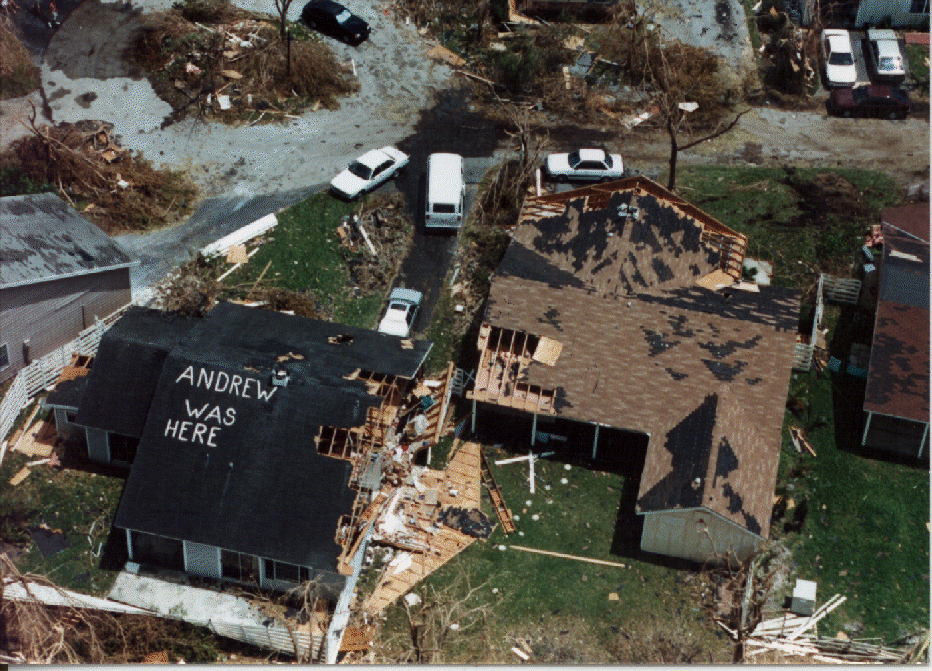
Obviously, by any metric Forecast A is superior – it was 100% accurate. But if you were a homeowner in Homestead, FL in 1992, you experienced one of the most devastating hurricanes of the 20th century and likely lost everything. Great forecast accuracy, but poor value.
What makes weather forecasts valuable? Accuracy is of course and important part of the equation, but value is more than that. The prediction should inform people on whether to take action and if so, what that action should be. For example, probability of precipitation forecasts are not perfect, but they are good enough that we can make an informed decision on whether we need our umbrella to go to work. Staying dry has value.
Let’s drill down a little bit on the seasonal prediction of North Atlantic tropical cyclones (TCs) and see if there’s any value to be found.
What are Seasonal TC Forecasts and Who Makes Them?
Each year, seasonal forecasts of tropical cyclone activity are issued by many organizations. Most forecasts are statistical in nature and rely on known relationships of hurricane activity to regional sea surface temperatures and large-scale wind patterns in the North Atlantic basin. They are called “seasonal forecasts” since they predict activity occurring over a season – in this case June-November – and are typically issued in the spring or at the start of the season on June 1. They are usually updated as the season progresses.
Bill Gray and his research group at Colorado State University (CSU) issued the first real-time seasonal forecast of hurricane numbers for the North Atlantic in 1984. In 1995, CSU began issuing seasonal forecasts on April 1, two full months before the official beginning of the North Atlantic hurricane season on June 1. Now, at least 30 seasonal predictions pour out of government, private, and academic institutions every year, each with their unique take on the upcoming activity. Typically, a seasonal forecast will predict the total numbers of tropical storms, hurricanes, major hurricanes (Category 3 or higher), and some measure of overall activity like storm days or Accumulated Cyclone Energy (ACE).
Are Seasonal TC Forecasts Accurate?
It would take a master’s thesis to validate all aspects of TC seasonal forecasts, so I’ll focus on one specific group (CSU), variable (number of hurricanes), and metric (root mean square error, RMSE). I chose the CSU group because they have the longest record and conveniently make all of their historical forecasts available on their website. There are many papers and sites out there (including from CSU) that present a more comprehensive validation of TC seasonal forecasts.
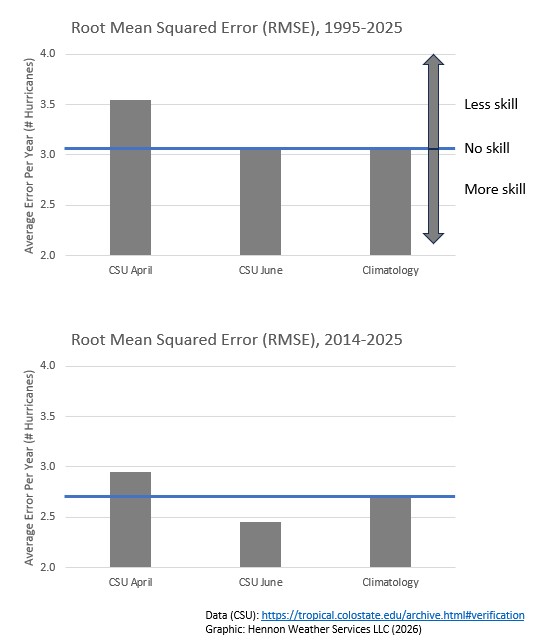
I first considered the most recent 31 years of seasonal forecasts (1995-2025). ‘Skill’ is measured relative to climatology, in this case the average number of hurricanes that have occurred over the period of record. If a forecast has zero skill, this means that we can just use the climatology (about seven hurricanes) as our forecast to the same effect – not good. The figure below shows that the CSU April forecasts – two months before the season begins – actually have negative skill. This means we’d be better off with the seasonal average than even trying. The June forecasts (beginning of the season) are marginally better but I’m still doing just as well with a climatology forecast.
Things get slightly better if we just consider the most recent 12 years (lower panel). CSU is still doing worse than climatology in April. The June forecast now has skill, but it’s pretty small – just 0.25 hurricanes of error less per year.
Are Seasonal TC Forecasts Valuable?
So, seasonal TC forecasts of hurricane numbers made prior to the season’s beginning are not accurate. Right away that pretty much limits their value. But what if they were accurate? What if we could make a perfect prediction of hurricane activity for the upcoming season. Is there value here?
There is ambiguity in answering this question, because it’s impossible to know how every individual or agency perceives value. In the example at the beginning of this article, I think it is clear that the Homestead homeowner would not believe that the seasonal forecast had value. The prediction was for a quiet, below average season – and his world got wrecked. It’s not the forecast’s ‘fault’ per se, it’s just the nature of the phenomena we’re predicting – even in quiet years we can get severe impacts.
Do government agencies like FEMA use seasonal forecasts to move equipment, budget for the response, or otherwise make any decisions? Does the general population see a seasonal forecast and then change what they do and how much they spend in their preparation for the season? Do local governments perform any planning based on these forecasts?
I suspect that answer is ‘no’ for all of these questions, but I’m not a part of these organizations so I could be wrong of course. I’d like to hear back from others if I am. But from my personal observations of people’s behavior and reactions to these forecasts over the years, there appears to be little if any value attached to seasonal TC forecasts. The forecasts generate a lot of media attention – which could be great if they were accurate – but do not motivate a public response.
Concluding Thoughts
Are seasonal TC forecasts just an academic exercise? Should we just abandon the endeavor? Certainly, they will get better as the science progresses and new tools (e.g., AI) and better data come online. But where will the value come from? I know if I were a coastal resident, a valuable forecast would be one that could inform me about the chance of impacts for my house. Until we develop a forecast that can provide good guidance for localized seasonal landfall probabilities – a much more daunting task – perhaps we should slow our roll on these seasonal predictions of activity.
Dr. Chris Hennon is the Founder and Lead Consultant for Hennon Weather Services LLC. He is a Certified Consulting Meteorologist and former Professor of Atmospheric Science with expertise in Tropical Meteorology and Weather Forecasting.
FAQ
Accuracy varies. Dr. Hennon’s analysis of CSU’s seasonal forecasts found that April forecasts have historically performed worse than simply using the long-term average (climatology), while June forecasts show a small but real edge.
Value depends on whether the forecast changes what people or agencies actually do. Broad seasonal totals generate media attention but don’t appear to strongly influence public preparation behavior.
Multiple organizations issue seasonal forecasts each year, including Colorado State University’s research group, which has published forecasts since 1984.